
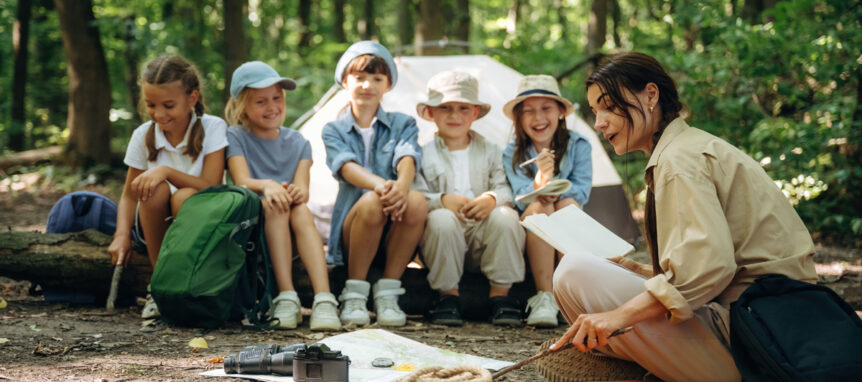
Children are naturally curious. They want to know why birds fly, how fish breathe underwater, what makes plants grow, and what might be hiding beneath a fallen log. As kids grow older and their schedules become more structured, however, they may have fewer opportunities to simply explore and follow their curiosity. Camp provides a setting where asking questions is encouraged and discovery is part of everyday life.
At Camp Live Oak, the natural surroundings of Hugh Taylor Birch State Park provide countless opportunities for children to wonder, investigate, and learn. From encountering South Florida wildlife to trying outdoor activities for the first time, campers are encouraged to look more closely at the world around them and discover answers through hands-on experiences.
Nature Is Full of Questions
Few environments inspire curiosity quite like the outdoors. A walk through a natural area can introduce dozens of questions without anyone needing to plan them. Why is that bird standing perfectly still beside the water? What made those tracks in the sand? Why do some insects live near water while others prefer trees?
At Hugh Taylor Birch State Park, campers are surrounded by diverse habitats and wildlife that can turn an ordinary day into an opportunity for discovery. Seeing an animal in its natural environment can be especially powerful because children aren’t simply learning a fact. They’re observing something happening right in front of them.
Those experiences encourage kids to pay attention to details and ask questions about what they see.
Hands-On Learning Makes Kids Want to Know More
Camp gives children the opportunity to learn by doing. Instead of only reading about the outdoors, they can experience it through activities and exploration.
Fishing, for example, can lead to questions about the different species living in Florida’s waterways, what fish eat, or why certain fish prefer particular habitats. Canoeing can inspire curiosity about aquatic ecosystems and the wildlife found near the water. Even a nature walk can turn into an investigation when campers encounter an unfamiliar plant, bird, or insect.
Hands-on experiences give children a reason to seek answers because the subject is directly connected to something they’ve just experienced.
Trying New Things Encourages Exploration
Curiosity isn’t limited to science or wildlife. It also plays an important role in helping children discover new interests.
Camp introduces kids to activities they may not regularly experience at home or school. A child who has never tried archery may become fascinated by how technique affects accuracy. Someone fishing for the first time might suddenly want to learn more about marine life. Another camper may discover an interest in art after creating something inspired by nature.
Trying something new teaches children that there is always more to discover. Even if an activity doesn’t immediately become a favorite, the experience encourages them to remain open to unfamiliar ideas and opportunities.
Questions Help Develop Critical Thinking
Asking questions is an important part of learning how to think independently. When children wonder why something happens, they begin considering possible explanations, gathering information, and comparing ideas.
Outdoor environments are particularly good for encouraging this process because answers aren’t always immediately obvious. Campers might observe an animal behaving differently than expected or notice changes in the weather and try to understand why.
Rather than simply being given an answer, children can be encouraged to observe more closely and think through different possibilities. This process strengthens problem-solving and critical-thinking skills that can benefit them in the classroom and everyday life.
Curiosity Grows Through Shared Discovery
Some of the best camp discoveries happen as a group. One camper may notice something unusual, another may have a theory about it, and suddenly everyone wants to investigate.
These conversations help children learn from one another. They also show kids that asking a question can lead to an interesting discussion rather than something they should feel embarrassed about.
Shared exploration encourages communication, teamwork, and confidence. Children begin to understand that they don’t have to know every answer. Being willing to ask questions and learn from others is valuable in itself.
Creating Lifelong Learners
One of the greatest benefits of encouraging curiosity is that it can extend far beyond camp. A child who becomes interested in a bird they spotted at the park may go home and research the species. Someone fascinated by fishing might want to learn more about marine ecosystems and conservation.
These small sparks of interest can develop into hobbies, academic interests, and even future careers. More importantly, they help children develop a mindset that sees learning as something exciting rather than something limited to school assignments.
Discover Something New at Camp Live Oak
Every trail, waterway, wildlife encounter, and outdoor activity presents another opportunity to ask, “Why?” or “How?” At Camp Live Oak, campers have the freedom to explore those questions while experiencing the natural environment of Hugh Taylor Birch State Park firsthand. By combining outdoor adventure with hands-on learning, camp helps children stay curious about the incredible world around them.
Curiosity can begin with something as simple as spotting an unfamiliar bird or catching a fish for the first time, but the desire to keep exploring can last a lifetime. To learn more about Camp Live Oak’s nature-based programs and upcoming camp experiences, contact Camp Live Oak today.